
How To Apologize In Italian
To start with a word to the wise: Italians are not prone to the sort of over-apologizing that’s customary in American or Canadian culture. At th

As a beginner on your quest toward Danish literacy, you might be weighing whether you have sufficient reasons to learn Danish. It’s definitely not the most pragmatic choice from a sheer numbers or necessity standpoint. There are only 5.6 million Danish speakers in the world; that’s considerably less than the population of New York City, to put things in perspective. Really, you probably won’t encounter much Danish outside of Denmark. And even there, Danes are the fourth best non-native English speakers in the world, meaning you can probably get by on your native language.
On top of that, Danish is one of the six hardest languages for English speakers to learn, almost entirely on account of its pronunciation. This can be a good thing or a bad thing depending on how motivated you are by a challenge.
But there are many compelling reasons to learn Danish, and they don’t all rest on the assumption that you take pleasure in obscure, difficult languages. Rest assured, though — we’re not arguing with you if you do.
Okay, so we’re not minimizing the fact that there are more than 20 vowel sounds and heaps of silent consonant clusters to pick your way around. But if you overlook the pronunciation, Danish is actually pretty easy to learn for English speakers. It has an easy, simple grammar and the word order is almost identical. Danish also only has one verb form per tense, regardless of who’s speaking. It’s also packed with cognates or words you’ll easily recognize because they sound similar to their English counterparts — Danish and English are both Germanic languages, after all.
If you’re a big movie buff, you’re probably aware that Denmark is solidly on the map for its film industry. It gained a lot of global notoriety in the 1990s, which was around the time that four of Denmark’s most promising directors — Lars von Trier, Thomas Vinterberg, Kristian Levring and Søren Kragh-Jacobsen — made a “vow of chastity” to abstain from Hollywood-style filmmaking. That meant they wouldn’t rely on big budgets and special effects. It’s not as though you can’t watch most foreign-language films in English, but being able to watch them in Danish (without subtitles, eventually) will lead to a more profound appreciation for Danish films.
Danish belongs to the East Scandinavian branch of the Germanic languages, which have Old Norse in common as an ancestor. Also in this subset are Norwegian and Swedish, which remain mutually intelligible. That doesn’t mean they’re exactly the same, but it does mean that speakers of any one of these languages can pretty easily understand speakers of the other two. Danish is arguably the odd one out when it comes to spoken mutual intelligibility, but the written forms of Danish and Norwegian are extremely similar — some would say almost identical. In either case, this gives you two additional reasons to learn Danish. With some obvious limitations, it’s kind of like getting three languages for the effort it takes to learn one.
If you have repatriation on your mind, Denmark is an appealing destination. It’s picturesque; it’s consistently ranked one of the happiest countries in the world; and its cities are functional and well-designed. Copenhagen is one of the best cities in the world for food lovers and bike riders, too.
And though you can easily get by on English as a tourist in Denmark — or even as a resident — you’ll find it worth your while to learn Danish if you plan on getting established there. For one, it’ll make dealing with local bureaucracy a lot easier. It’ll also make you more competitive in the local job market. When it comes down to it, Danish speakers are more likely to get the job than non-Danish speakers. Lastly, and perhaps most importantly, it’ll open doors for you socially and culturally. Danish culture can be somewhat insular, and you’ll have an easier time making real connections when you speak the local language.
Though we may be somewhat past the peak of the hygge craze in the United States, the allure of this extremely Danish ethos persists. Hygge has no exact translation, but it has to do with coziness and comfort — the appeal of a crackling fire, a pleasant atmosphere, the company of your favorite people, and the delight in simple pleasures and relaxation. Hygge is also used in essential phrases like Hyggeligt at møde dig (Nice to meet you) and Hyg jer! (Make yourself cozy!). Learning Danish will unlock not only the meaning of these phrases, but also the deeper meaning of the Danish way of life.

To start with a word to the wise: Italians are not prone to the sort of over-apologizing that’s customary in American or Canadian culture. At th

Holiday music is a divisive issue. Some people love the time of year when sleigh bells and Dean Martin rule the air waves, while others don’t ne

Subscribe to Multilinguish on Apple Podcasts, Spotify, Google Play, Stitcher or wherever you listen. No matter who you are, 2020 was probably a rough

You would think that figuring out the name of a country wouldn’t be too difficult. I mean, Germany is just called Germany (then again, that can also b
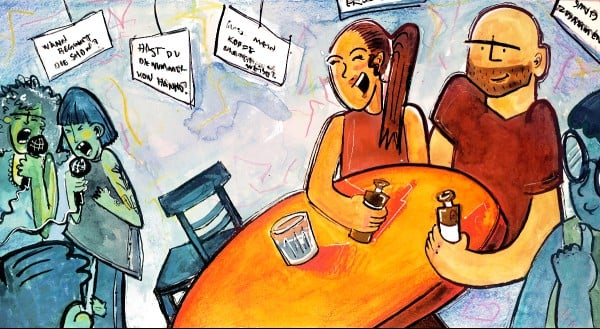
Illustration: Daniel Marin MedinaWhen looking for the perfect tandem partner, it’s easy to feel like Goldilocks. When I moved to Berlin seven years ag

Canadian English seems neither here nor there in the grand scheme of English varieties. On the one hand, Canadians prefer the “British” spelling of wo

Subscribe to French en route on Apple Spotify Spreaker or wherever you get podcasts. A New Podcast For French Learners When you’re learning a ne

There comes a time in every language learner’s journey when it becomes necessary to learn a quick apology or two. Usually, this time comes prett
We are a comprehensive and trusted information platform dedicated to delivering high-quality content across a wide range of topics, including society, technology, business, health, culture, and entertainment.
From breaking news to in-depth reports, we adhere to the principles of accuracy and diverse perspectives, helping readers find clarity and reliability in today’s fast-paced information landscape.
Our goal is to be a dependable source of knowledge for every reader—making information not only accessible but truly trustworthy. Looking ahead, we will continue to enhance our content and services, connecting the world and delivering value.