
Cursing Abroad: Polish Insults To Round Out Your Studies
If you want to stay on a Polish person’s good side, there are three major faux pas you’ll want to avoid. One is making any sort of ahistor

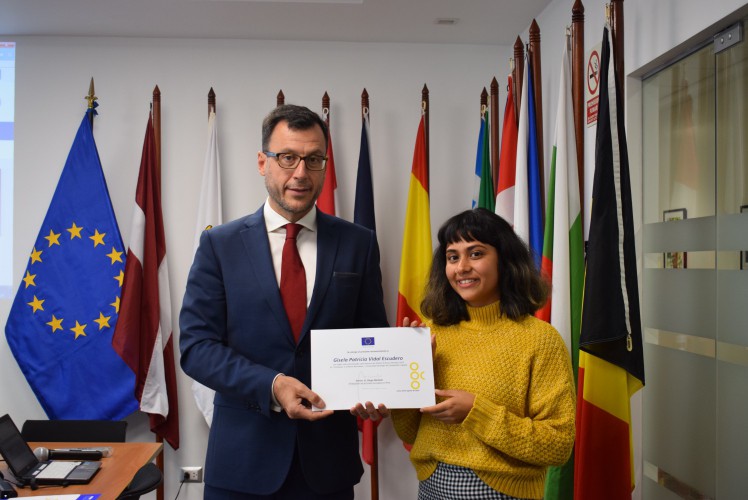
At Babbel, we believe that language is the key to unlocking higher education, whether that’s out in the world or in the classroom. That’s why we launched the UK Babbel Scholarship, committed to giving £2000 in prize money and access to Babbel for one year. The winner was clear to us as soon as we read Gisela Patricia Vidal Escudero‘s application, which outlined an academic journey that saw her overcome educational inequities and use her intersectional studies to bridge agro-ecological divides. Above all, her writing shone a light on her commitment to inclusivity, a value that we hold near and dear to our hearts. Read on to find out more about Gisela’s multilingual education.
Editor’s note: This interview has been edited for length and clarity.
I am a Peruvian woman proud of my Andean heritage. Currently, I am a graduate student funded by the European Union Commission for the Master Joint Degree Crossways in Cultural Narratives between the University of St Andrews (UK), Universidad de Santiago de Compostela (Spain) and Université de Perpignan (France). Before starting this adventure in Europe, I backpacked across Latin America for two years. Deep in my heart, I see myself as a traveller.
To me languages are related to the act of traveling in its broadest sense. I studied literature so I would say that I fell in love with words through books. Reading is a radical gesture toward otherness. We travel to other times, spaces and bodies. In these itineraries, languages open doors to us, challenge our imagination and the ways we see others and ourselves. In a more practical sense, because of my language skills, I was able to get access to scholarships that opened up the doors of higher education and to spaces of cross-cultural research, such as the Harvard Institute for World Literature.
Both of my parents are native speakers of Quechua, an indigenous language from South America. I grew up with the sense that speaking Quechua was something shameful. My parents refused to teach me their mother tongue because it is associated with racial discrimination practices that have persisted in my country since colonial times. Native speakers of indigenous languages are forced to learn dominant languages in order to have access to the dominant health, education and legal systems. To learn languages that have been systematically considered worthless is a gesture that recognises the dignity and value of their speakers. It is also a powerful action to decolonize knowledge.
Multi-linguistic skills definitely unlock educational and professional opportunities. Intercultural competence is highly valued by Selection Committees. You are so much more than your GPA! At a more intimate level, to speak another language is an intellectual and an emotional journey. Frequently, the love for a language takes you to another country. So you might be missing out the gift of leaving your comfort zone: boldness is a virtue that is always rewarded.
Instead of ‘overrated,’ I would definitely say that there are definitely dominant languages. At a global level, everyone points fingers at English. However, languages are living phenomena. There is always space for resistance through creative appropriation. Disadvantaged people are very aware of this and all kinds of subversions are made by different communities of speakers. Language changes from below: That is the beauty of global English.
My native language is Spanish. I speak French and English with confidence and I am in the process of improving my German. Additionally, I studied Latin at University and I can read in Galician. For me, persistence is the key to picking up a language. I have realised that the ‘affordable’ language classes in the UK are once per week. Based on my own experience, the outcome of that rhythm is rather frustrating. Fortunately, the Web 2.0 World is a wild one, where you can encounter neatly structured and personalized learning experiences such as Babbel’s. Additionally, daily practice doesn’t have to be boring! I am the co-ordinator of the Spanish Cafe at St Andrews University and this is an enjoyable chance to chat with native speakers. I would say that in most of the cities that I have lived, from San Cristobal de las Casas to Edinburgh, you can always find coffee shops that offer informal gatherings for language exchange. The secret is to show up.
It’s important that universities promote learning languages as part of their commitment to diversity. Multilingualism is the most welcoming gateway to a truly international education. Regarding Babbel, I believe that the website could offer awarded challenges or membership incentives to users that achieve a certain level of commitment in their language practices (Editor’s note: We’re already working on it!).
My ideal world is one that celebrates its differences. So I would love to see more people taking up new languages and bridging gaps between cultures and communities that disentangle stereotypes from real people. We get immersed in a world full of prejudices when we get caught up in our small little bubbles with people that look and think just like us.
In the future, I see myself working between wor(l)ds. Currently, I am trying to pursue a career in academia. I am aware that there is a lot of pessimism surrounding the gap between academic practices and political action. However, I believe the task at hand is to transform universities into more inclusive and diverse sites of production and decolonization of knowledge. Even if I don’t end up thriving in the narrow academic job market, l dream about working in an organization devoted to the democratisation and internationalization of education.
I heard about Babbel by word of mouth during the years that I have lived in youth hostels and most recently from graduate students in Cambridge. What I love about Babbel is the fact that people from such diverse backgrounds can benefit from a learning experience that used to be reserved for small privileged groups. Therefore, when the School of Modern Languages at St Andrews shared news of the scholarship, I knew that I wanted to have an opportunity to be part of this project. My wonderful and supportive Professor David Evans from the French Department encouraged me through the application process.
Thanks to the support of Babbel, I will continue to improve my German skills through their digital learning platform, which also offers small live classes. In the future post-Covid world, I will use this award to travel to India and study Hindi and Urdu because I am interested in looking at the intersections and parallels between Latin American and South Asian literary cultures.

If you want to stay on a Polish person’s good side, there are three major faux pas you’ll want to avoid. One is making any sort of ahistor

Learning a language online is becoming an increasingly popular option. When you can’t make it to Norway in person, using the internet in Norwegi

Most of us come to language learning for the most noble and respectable reasons, but let’s be real: you probably couldn’t wait for someone

As a beginner on your quest toward Danish literacy, you might be weighing whether you have sufficient reasons to learn Danish. It’s definitely n

When you think “English accent,” maybe you immediately imagine someone who speaks as poshly as the royal family. This accent — called “Received Pronun

It might seem too easy to say that watching a movie in your learning language counts as studying, but if you do it the right way it really can help yo

Reading a book in its original language is, in our opinion, one of the best parts of learning a new language. Sure, literature in translation is great

At Babbel, our endgame is getting people to have conversations with other people, in a new language. There are fantastic folks here making that possib
We are a comprehensive and trusted information platform dedicated to delivering high-quality content across a wide range of topics, including society, technology, business, health, culture, and entertainment.
From breaking news to in-depth reports, we adhere to the principles of accuracy and diverse perspectives, helping readers find clarity and reliability in today’s fast-paced information landscape.
Our goal is to be a dependable source of knowledge for every reader—making information not only accessible but truly trustworthy. Looking ahead, we will continue to enhance our content and services, connecting the world and delivering value.